Over the past decade, automotive simulation has mainly developed through simracing and entertainment. While visually advanced, most simulators remain disconnected from engineering workflows, limiting their relevance for professional training, vehicle analysis and performance engineering. At J3DMODDING, we take a different approach. Our work is driven by a clear principle: automotive simulation can be used as an engineering tool, alongside data analysis software, test benches and driver-in-the-loop systems.
SIMULATION AS A TECHNICAL INSTRUMENT
Using simulation as an engineering tool implies strict requirements :
-
physically coherent vehicle models,
-
repeatable and measurable behavior,
-
predictable response to setup and driving inputs,
-
compatibility with structured analysis and coaching workflows.
In this context, simulation is not a product to be consumed, but a medium to work with.
This approach remains uncommon in France and internationally, as it requires both :
-
a deep understanding of vehicle physics,
-
the ability to translate real-world engineering constraints into simulation models.
ENGINEERING-GRADE VEHICLE MODELS
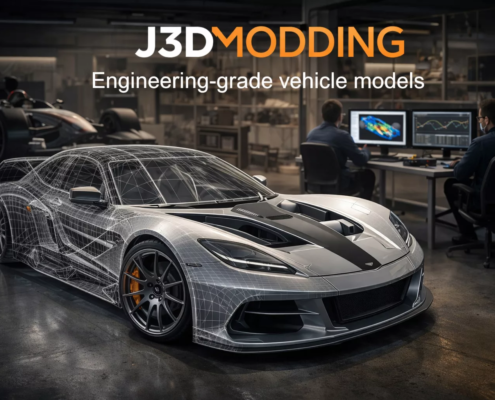
J3DMODDING operates as a technical simulation provider, delivering vehicle models specifically developed for engineering analysis and professional training.
Each model is built with a focus on:
-
realistic mass distribution and inertial properties,
-
suspension geometry and kinematic accuracy,
-
tyre and aerodynamic behavior suitable for structured analysis,
-
numerical stability required for repeatable engineering workflows.
Visual fidelity remains secondary to physical credibility and overall model consistency.
The result is not a “sim racing car”, but a functional digital twin designed for use in professional environments.
APPLIED EXAMPLE : PROFESSIONAL ENGINEERING ENVIRONMENT
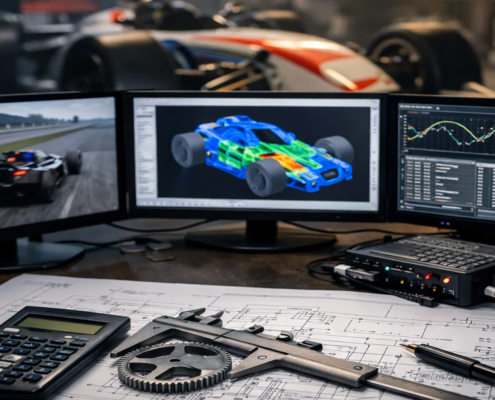
This methodology is applied in real professional contexts, including collaborations with RSP Engineering, where simulation is used as a support tool for engineering analysis and driver development.
In this environment, simulation enables :
-
driver-in-the-loop analysis,
-
objective evaluation of driving technique,
-
structured coaching sessions,
-
technical explanation of vehicle behavior and setup effects.
The simulator becomes an engineering workspace, not a showcase.
WHY THIS APPROACH IS DIFFERENT
What differentiates this approach from conventional simulation usage is not the software, but the intent.
Simulation is not used to feel fast,
but to understand why performance changes.
Not to entertain,
but to explain, analyze and train.
This positioning requires simulation assets designed from the outset around engineering logic, rather than adapted afterward from gaming-oriented content.
PROFESSIONAL AND CONTROLLED FRAMEWORK
All developments are delivered within a strictly defined professional framework :
-
B2B use only,
-
no public or entertainment-oriented distribution,
-
internal use for engineering, training and coaching,
-
compliance with manufacturer data and intellectual property constraints.
This framework is essential to preserve the technical integrity and credibility of the simulation work.
CONCLUSION
Automotive simulation reaches its full value when treated as an engineering instrument rather than an entertainment product.
By delivering engineering-grade vehicle models and integrating them into professional workflows, J3DMODDING contributes to a more rigorous and structured use of simulation in motorsport and automotive engineering.
When properly designed and applied, simulation becomes a practical tool for analysis, training and performance understanding, fully aligned with real-world engineering practices.